

Introduction to the Voodoo Lily (Amorphophallus)
Amorphophallus plants are also sometimes known as penis plants due to their distinctive flowers. These fascinating plants particularly attract attention with their unique appearance and very special flowers. Originally, penis plants stem from the tropical forests of Southeast Asia, Africa, and South America, where they thrive in warm, humid conditions.
The plants have been an integral part of various cultures throughout history and have had different meanings and uses. In some cultures, they were considered symbolic of fertility and were used in rituals and ceremonies. Others used them as a source of food, as some species produce edible tubers that can be prepared in various ways. It is especially the species Amorphophallus konjac that is grown for consumption (Konjac) and is used for things such as flour, cake, noodles, and yam. We also grow Amorphophallus konjac (also known as Devil's Tongue) ourselves, although not for consumption, but as an ornamental plant.
Today, Amorphophallus plants still enjoy a prominent place in both botanical collections and private gardens all over the world due to their unique and impressive appearance. The Botanical Garden in Copenhagen, for instance, has a fine collection of different species of Amorphophallus and has several times had their large Amorphophallus titanum in bloom, which is always a crowd-puller.
The world's largest flower!
Among the Amorphophallus family, Amorphophallus titanum, also known as the "corpse flower" or "titan arum," is the most famous. It is known for its impressive size and characteristic appearance. Amorphophallus titanum does not only form the largest flower in the Amorphophallus family, but also the largest flower in the world measured by volume.
This remarkable plant has an unusual growth cycle and flowers only rarely. When it blooms, its flower can reach heights of up to 3 meters or more and has a characteristic reddish-brown color with a variety of green shades.
Amorphophallus titanum is unfortunately quite hard to come by. This is partly because it does not produce side-tubers, as many of the other species do. It is therefore more difficult to propagate and, in addition, very rare (and expensive) on the market. Sometimes one can be lucky enough to get hold of seeds or plants, but you have to be quick. We have a few plants ourselves that we have been lucky to get from seeds. We also propagate these, and from time to time there will be a plant available in the webshop.
Pollination and smell
One of the most fascinating characteristics of Amorphophallus is its characteristic smell, which is often described as rotting meat. This strong odor attracts flies and beetles that would normally be attracted to rotting organic material. This is an adaptation that helps attract pollinators to the flower. However, it can be a challenge for the enthusiastic plant grower, who most often must place the plant well away while the smell is at its strongest. Fortunately, this only lasts a few days before the plant is pleasant to be around again.
Care of Amorphophallus plants
Amorphophallus plants are actually relatively easy to care for if you take your precautions. It is especially their dormant/winter period that can be a bit tricky. The fact is that the vast majority of species die down every autumn and remain in the soil as a tuber until next spring. Some species benefit from staying in the soil, while others should be taken up. In general, however, they must be kept very dry during this resting period. So, one must be aware of that. As a plant, however, they are relatively easy to look after and are cared for like most other houseplants. The acquisition of plants usually happens via tubers, but it is sometimes also possible to acquire seeds. The seeds can be a bit tricky to get to germinate, however.
By following these guidelines for light, temperature, watering, humidity, fertilization, and rest, you can ensure that your Amorphophallus plants thrive and bring their unique beauty into your home or office. The guidelines are general. For specific information, it is best to look under each individual species on the webshop.
-
Light conditions
Amorphophallus plants thrive best in indirect, but bright light conditions. Avoid direct sunlight, as this can cause damage to the leaves. An east or west-facing window is ideal, as it provides sufficient light without exposing the plant to direct rays. In summer, they can be placed outside in a place protected from strong sun and wind. Some can even be planted out in the garden.
-
Temperature
These plants prefer warm and humid conditions, which resemble their natural habitat in tropical forests. Keep the temperature around 15-25°C during the day and avoid sudden temperature changes, as this can be stressful for the plant. There has been some experimentation with overwintering some species (in their dormant state) outdoors in winter, even in freezing temperatures. See below for a list of species where this might be possible.
-
Watering
It is important to keep the soil evenly moist, but not soaked. Let the soil dry out slightly between waterings to avoid the roots rotting. Use rainwater if possible.
-
Humidity
Since Amorphophallus plants originate from tropical areas, they enjoy high humidity. You can increase the humidity around the plant by regularly spraying the leaves with a mister with lime-free water (this avoids limescale spots on the leaves). Therefore, avoid placing the plant in front of a radiator, heat pump, or similar, which makes the air very dry.
-
Fertilization
Fertilize the plant with a weak, balanced fertilizer every two weeks during the growing season (spring and summer). No fertilizer when the plant is resting/as a tuber.
-
Resting period
At some point, Amorphophallus will enter its resting period, where it naturally loses its leaves and goes dormant. This is a normal part of its growth cycle. Reduce watering significantly during this period. When the plant has died down completely, very little watering is required. At this time, you can also take the tuber out of the soil and thereby check if small side-tubers have formed that will become new plants the year after (a few species, for example, A. titanum and A. bulbifer, do not form side-tubers in the soil). The free tubers are stored in the dark (at room temperature or cooler) and sprayed with a little water approximately once a month.
When the new growth can be seen on the tuber (a pink growth forms in the middle), the tuber is planted again in new, nutrient-rich soil, and watering is increased gradually. Only when the leaf is completely up from the soil is it watered in the normal way.
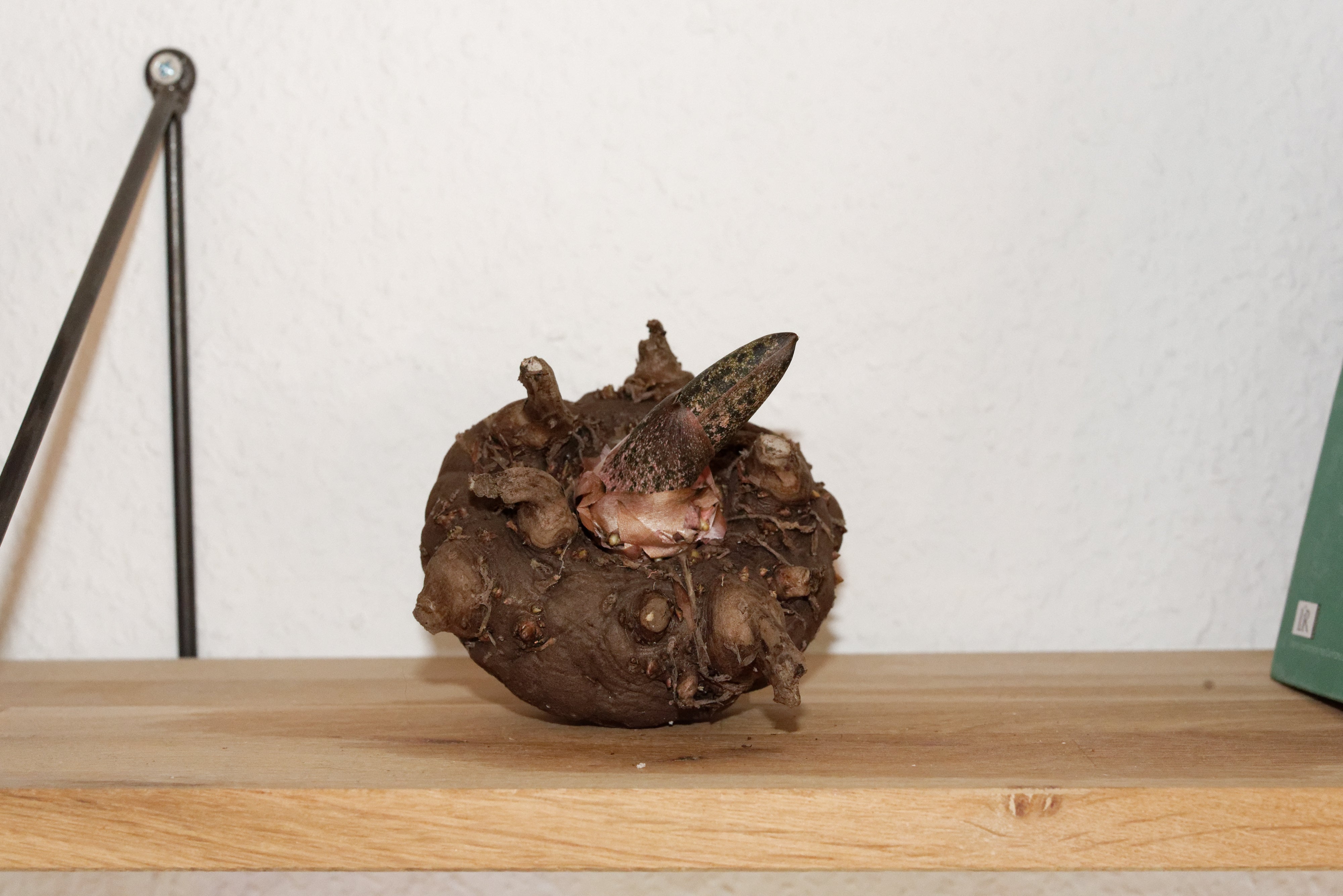
Frost-tolerant species:
Some species of Amorphophallus can, during their dormancy, tolerate frost and can thus be grown outdoors in Denmark. Most attempts at this have been made in the USA, and there is therefore no guarantee that the same applies here at home. We do, however, regularly try to overwinter Amorphophallus outdoors and will continuously add information here when we have it. In general, we recommend some form of winter covering – for example, by covering the soil with straw or spruce. The following species should be able to overwinter outdoors in Denmark:
- Amorphophallus albus
- Amorphophallus bulbifer
- Amorphophallus konjac
- Amorphophallus kiusianus
- Amorphophallus napalensis
- Amorphophallus odoratus
- Amorphophallus paeoniifolius
- Amorphophallus yunnanensis
Enjoy your penis plants :)