
Collection: Papaya (Carica sp.)
Papaya is one of those plants that quickly brings to mind warmer climates. With its large, hand-shaped leaves, rapid growth, and distinctive fruits, a papaya plant is both exciting to grow and decorative to have around.
The common papaya, Carica papaya, originates from tropical regions of the Americas but is grown in many parts of the world today. Under the right conditions, it grows quickly and can develop from a small seedling into an impressive plant in a relatively short time.
With us, you will find various varieties and types of papaya, including dwarf forms and other exciting variants that can be grown from seed. This makes papaya an obvious project for those who would like to try their hand at exotic fruit plants.

Buy 4 packs of seeds (or more) and get a 10% discount
-
Papaya (Carica papaya) (Honey Dew) | seeds, 20 pcs.
Regular price €5,95 EURRegular price -
Papaya (Carica papaya) (Dwarf) | seeds, 15 pcs.
Regular price €5,95 EURRegular price -
Mountain Papaya (Carica pubescens) | seeds, 10 pcs.
Regular price €5,95 EURRegular price -
Papaya (Carica papaya "Cauca") | seeds, 10 pcs.
Regular price €6,95 EURRegular price
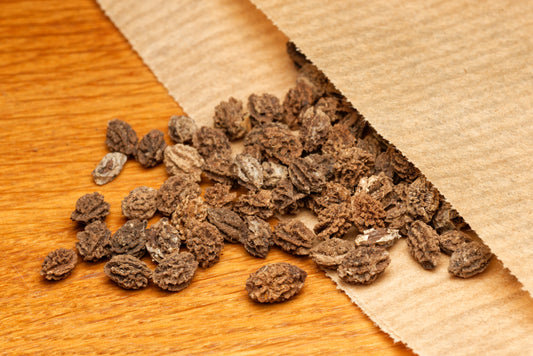
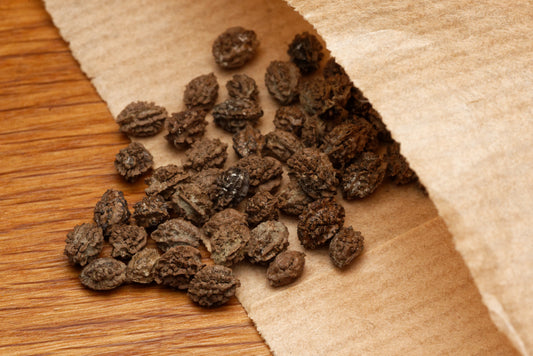
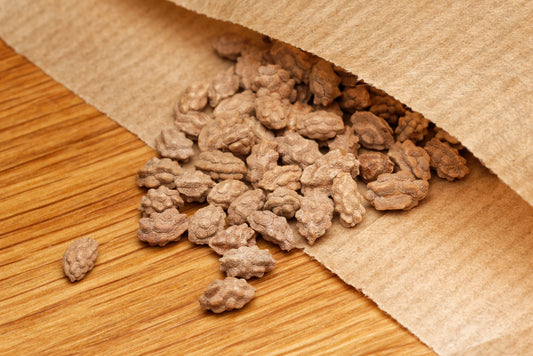
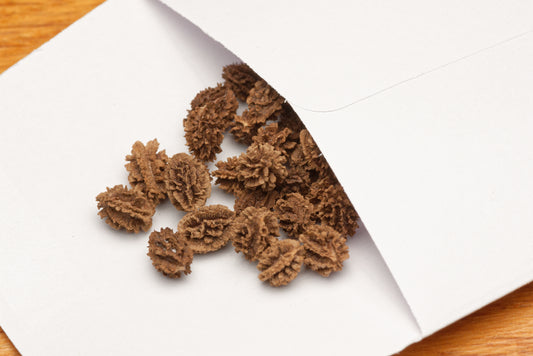

Papaya seeds
Papaya is relatively easy to grow from seed, and it is an exciting plant to follow right from germination.
In the right conditions, the dark papaya seeds develop into fast-growing seedlings with characteristic lobed leaves. The seeds need warmth to germinate well, so a warm spot is a great advantage. Furthermore, it is important to germinate the seeds together, as they release a hormone that encourages them to sprout.
In our selection, you will find various papaya varieties, including:
- Carica papaya 'Dwarf' – a more compact type of papaya
- Carica papaya 'Honey Dew'
- Carica papaya 'Cauca'
- Mountain papaya – a papaya-like species from cooler mountain regions
The different types can vary in growth, size, and requirements, so it may be worth choosing a variety based on the conditions you can offer the plant.

Papaya as an exotic plant
A papaya plant changes appearance quickly.
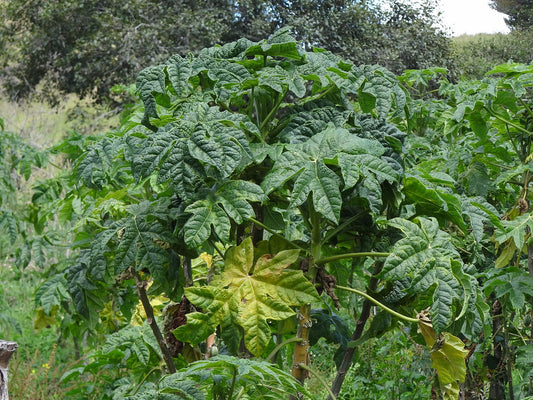
While many exotic plants require great patience, a papaya can grow quite rapidly under good conditions. The first leaves on a seedling are relatively simple, but gradually the plant develops the large, deeply lobed leaves that characterize an adult papaya.
This makes it fun to follow from seed.
Papaya is particularly well-suited for those who want to grow tropical fruit plants and at the same time desire a plant with large leaves and a striking look.

Papaya care
A papaya originates from tropical regions and therefore thrives best with warmth and plenty of light.
The most important aspects of caring for a papaya tree are:
- Plenty of light – preferably several hours of direct sunlight
- Warm temperatures and protection from the cold
- Even watering without the soil being constantly wet
- Airy and well-drained soil
- Regular fertilization during the growing season
- Papaya grows quickly when it thrives and therefore needs both water and nutrients during the growth period.
At the same time, the roots do not like to stand in wet and compact soil. A pot with good drainage and an airy soil mixture is therefore important.
In winter, growth will typically slow down in Denmark due to less light. During this time, watering should be reduced so the plant does not remain too moist.

What is a papaya
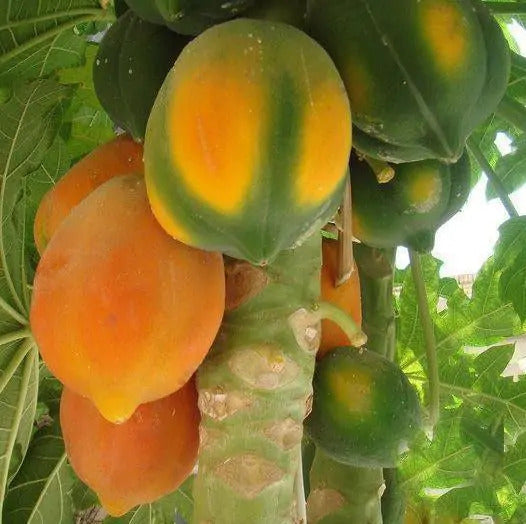
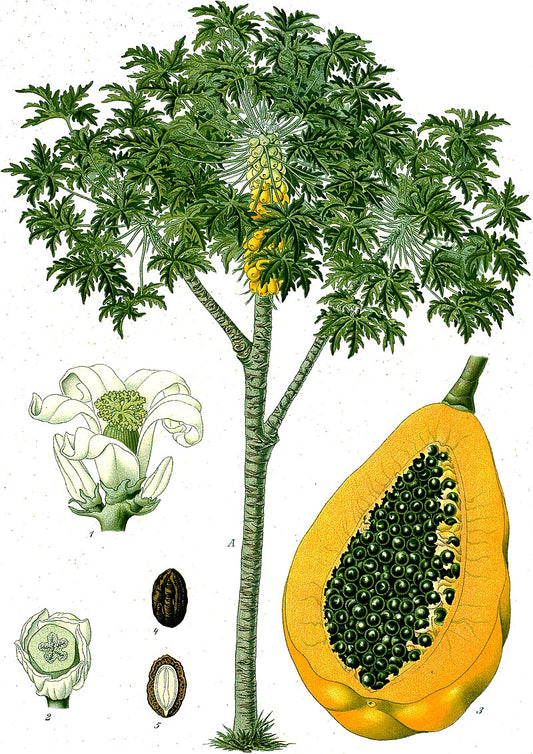
Papaya is a tropical plant, best known for its large orange, yellow, or greenish fruits.
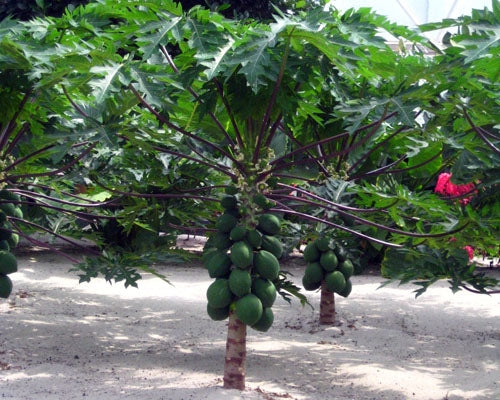
Although the plant is often called a papaya tree, botanically it is not a tree in the same way as, for example, an apple tree. It develops a tall, relatively soft trunk with a crown of large leaves at the top, which gives it a distinctly tree-like appearance.
The fruits develop close around the trunk under the leaf crown and can become quite large in some varieties.
Papaya is grown primarily for its fruit, but as a potted plant, it is also interesting simply because of its tropical look and rapid growth.
-
Growing papaya from seeds
If you want to grow papaya from the very beginning, heat is one of the most important factors.
Papaya seeds can be sown in a light and well-drained sowing medium and placed in a warm spot. Remember to sow them together. Keep the soil slightly moist during germination, but avoid making it waterlogged. Once the seeds have sprouted, the small plants should quickly be given access to plenty of light. Too little light can result in long and weak plants.
As the plant grows, it can be repotted into a larger pot. It is worth remembering that germination time and germination rate can vary. Seeds are living material, and temperature, humidity, and the individual characteristics of the seeds all have an impact on the result. -
Papaya tree in Denmark
It is possible to grow a papaya tree in Denmark, but the climate means that the plant usually must be grown in a pot, greenhouse, or indoors.
Papaya does not tolerate frost and generally does not like low temperatures. During the summer, the plant can be kept in a very bright and warm location and can potentially be moved outside once temperatures are stable.
However, it must be gradually acclimated to direct sun if it has been kept indoors. Before the autumn gets cold, the plant must be moved back to a frost-free and bright location. A greenhouse or a very bright conservatory naturally provides better opportunities for creating the warm and long growing season that papaya prefers. -
Can you get fruit on a papaya in Denmark?
It is possible, but it requires good conditions. For a papaya to bloom and develop fruit, the plant needs plenty of warmth, light, space, and nutrients. The Danish winter with its short days therefore makes cultivation more challenging than in tropical areas.
Some varieties are more compact and may be better suited for cultivation where space is limited.
It is also important to be aware that papaya plants can have different flower types. Therefore, not all individual plants will necessarily be able to bear fruit on their own. However, many grow papaya just for the experience and the beautiful plant – and consider any home-grown fruit as an extra bonus.
Buy papaya seeds online
At a Piece of Nature, you will find papaya seeds from several different varieties and types, so you can grow the plant yourself right from the beginning.
We offer, among others, seeds from various forms of Carica papaya as well as mountain papaya. Our selection varies continuously as we find opportunities to source new and exciting varieties.
Papaya is a great choice for those who want to grow a fast-growing exotic plant and experience its entire development from a tiny seed to a large tropical plant. Whether your goal is to grow your own papaya plant, experiment with tropical fruit plants, or perhaps one day harvest a home-grown papaya, it all begins with a seed.
Frequently asked questions about papaya
Is papaya a tree?
The papaya is commonly called a papaya tree due to its tall stem and crown of leaves, but botanically it is a large herbaceous plant and not a true tree with a woody trunk.
How big does a papaya tree grow?
The size depends a great deal on the variety and growing conditions. Common papaya plants can reach several meters in height under optimal conditions, while dwarf varieties typically remain more compact and are therefore easier to manage as potted plants. In general, plants grown in pots remain smaller than those in nature.
Can you grow papaya in Denmark?
Yes, papaya can be grown in Denmark, but the plant must be protected from cold and frost. It is therefore typically grown indoors, in a greenhouse, or in a pot that can be moved inside during the winter.
Can a papaya plant bear fruit in Denmark?
Yes, it is possible, but it requires very good conditions with warmth and plenty of light. A greenhouse or a bright conservatory can make it easier to provide the plant with a sufficiently long growing season.
Can you eat the fruits of a papaya grown in Denmark?
Yes, you can. However, the taste depends a lot on which variety it is and the conditions the plant has had.
How do you take care of a papaya tree?
A papaya tree needs plenty of light, warmth, regular watering, and nutrients during the growing season. At the same time, the soil should be well-drained, as the plant does not thrive with constantly wet roots.
How do you sow papaya seeds?
Papaya seeds are sown in an airy and well-drained seed compost and placed in a warm location. Place the seeds together. The soil should be kept slightly moist during germination. When the seeds germinate, the small plants should receive plenty of light.
How fast does a papaya tree grow?
Papaya can grow quickly in warm and bright conditions. How fast it develops depends, among other things, on the variety, temperature, light, pot size, water, and nutrients.