Buy 4 packs of seeds (or more) and get a 10% discount


a Piece of Nature
Okra (Abelmoschus esculentus) | seeds, 10 pcs.
Okra (Abelmoschus esculentus) | seeds, 10 pcs.
Couldn't load pickup availability
- Latin name: Abelmoschus esculentus
- Danish names: Okra, okrahibiscus
- English names: Okra, lady's fingers, gumbo
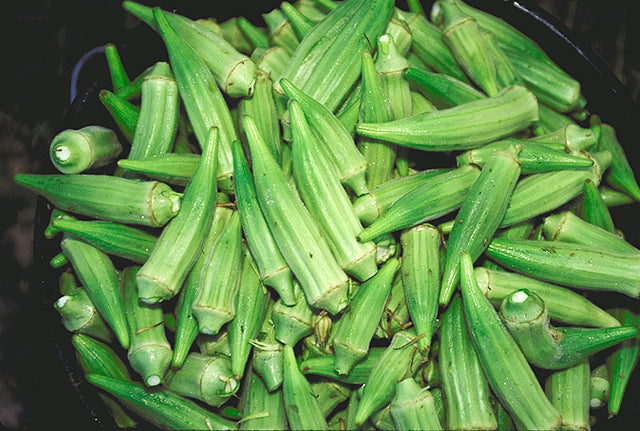
Abelmoschus esculentus, better known as okra, is an exciting and ancient crop plant cultivated for its characteristic edible seed pods. The species belongs to the mallow family (Malvaceae) and is thus related to, among others, hibiscus – a kinship that is easy to recognize when the plant opens its large, elegant flowers.
The origin of cultivated okra has been debated, but the plant has a long history of cultivation in Africa and Asia and is today an important vegetable in warm regions across large parts of the world. It is used in, among others, African, Middle Eastern, Indian, Caribbean, and South American cuisines, as well as in the American Southern dish gumbo.
The plant grows quickly and develops an upright stem with large, palmately lobed leaves. The decorative flowers are typically cream to light yellow with a dark wine-red center and resemble hibiscus flowers. After flowering, the elongated, ribbed seed pods develop, which are harvested young and tender.
Okra is especially known for its high content of mucilage, which is released when the pods are cut and cooked. This property is traditionally used to thicken soups and stews, but the pods can also be fried, grilled, pickled, or cooked whole.
Cultivation and requirements
Abelmoschus esculentus loves heat and sun and develops best under conditions that resemble a truly warm summer. It prefers:
- Full sun
- Nutrient-rich and well-drained soil
- Regular watering during the growing season
- Fertilization with good organic fertilizer
- A warm and sheltered growing site
Okra is fast-growing and nutrient-demanding. Good, nutrient-rich vegetable soil combined with regular organic fertilizer throughout the growing season gives the plant good conditions for both growth, flowering, and the formation of seed pods.
In Denmark, okra can be grown as an annual plant. The best results are usually obtained in a greenhouse or in a very warm and sunny spot, as the plant requires a relatively long and warm growing season to provide a good yield.
Cultivation from seed
Okra is relatively simple to grow from seed, provided it receives sufficient heat.
- It is recommended to soak the seeds in lukewarm water for 12–24 hours before sowing
- Sow the seeds 1–2 cm deep
- Keep the temperature around 22–28 °C
- Keep the soil evenly moist, but not wet
- Give the young plants as much light as possible after germination
Pre-cultivation indoors gives the plant an important head start under Danish conditions. As okra does not tolerate frost, the plants should only be moved to a greenhouse or outdoors when the risk of cold nights is over and the temperature is stable.
The young seed pods grow surprisingly fast after flowering. If they are to be used in the kitchen, they should be harvested while they are still young and tender. If they are allowed to mature on the plant, the pods gradually become hard and fibrous and develop mature seeds instead.
Utility and collector value
Abelmoschus esculentus combines a utility plant and an ornamental plant in a particularly fine way. The hibiscus-like flowers make the plant decorative in the greenhouse or vegetable garden, while the subsequent seed pods offer the possibility of harvesting your own okra.
The young pods are a classic ingredient in a wide range of food cultures worldwide. The name "lady's fingers" refers to their long, slender shape, while the term "gumbo" is used for both okra and the famous dish from Louisiana, where okra is traditionally used as a thickener.
Abelmoschus esculentus is therefore an obvious choice for those who would like to grow a different type of edible plant from seed – a fast-growing, heat-loving vegetable with beautiful hibiscus-like flowers and a long cultural history. See also our entire exciting selection of seeds here.
Seed germination
Seed germination
Childcare
Childcare
Size
Size
Up to 1 meter high
Difficulty level
Difficulty level
Easy
NB
NB
The fruits are used for thickening and produce some "mucilage"